
OEM vs Private Label Jeans Manufacturing
OEM vs private label jeans manufacturing are two core production models in the denim and apparel industry that define how a clothing brand sources, designs, and produces jeans.
A jeans manufacturing model determines:
- who controls the design
- how production happens
- pricing structure
- MOQ (minimum order quantity)
- speed of market entry
In India’s denim manufacturing ecosystem, both OEM and private label models are widely used by startups, D2C brands, wholesalers, and export buyers.
What Is OEM Jeans Manufacturing?
OEM (Original Equipment Manufacturer) jeans manufacturing is a production model where the brand provides the design, and the factory manufactures the product exactly as specified.
In this model, the manufacturer acts as a production partner, not a designer.
Key characteristics of OEM jeans manufacturing:
- Brand owns complete design control
- Factory follows tech packs and specifications
- Custom fabric selection and GSM control
- Custom washes (acid wash, stone wash, enzyme wash)
- High level of product customization
👉 OEM is commonly used by established fashion brands and export buyers who need unique product identity.
What Is Private Label Jeans Manufacturing?
Private label jeans manufacturing is a model where the factory provides ready-made or semi-designed jeans, and the brand applies its own branding.
The manufacturer controls design, while the brand focuses on marketing and sales.
Key characteristics of private label jeans manufacturing:
- Pre-designed denim styles
- Low customization required
- Fast production cycle
- Brand adds logo, tags, and packaging
- Lower entry barrier
👉 This model is widely used by startups, Amazon sellers, Flipkart sellers, and D2C brands.
OEM vs Private Label Jeans Manufacturing: Key Differences
How do OEM and private label models differ?
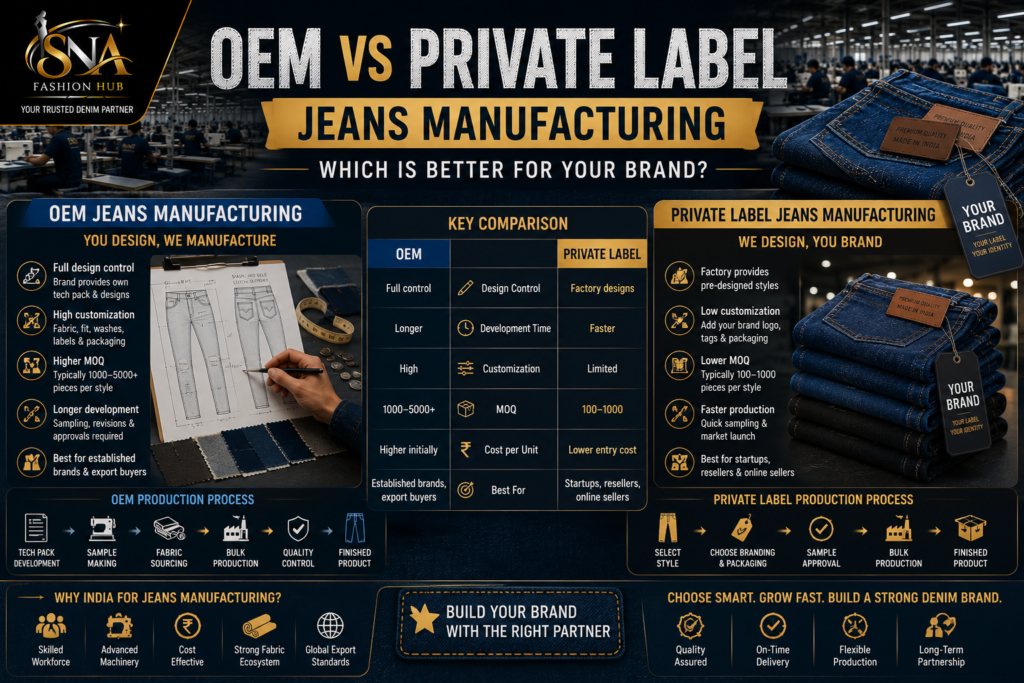
The difference between OEM and private label jeans manufacturing is based on control, cost, and speed of execution.
| Factor | OEM Jeans Manufacturing | Private Label Jeans Manufacturing |
| Design Control | Full control by brand | Factory provides designs |
| Development Time | Longer | Faster |
| Customization | High (fabric, fit, wash) | Limited |
| MOQ Requirement | Higher | Lower |
| Cost per Unit | Higher initially | Lower entry cost |
| Best For | Established brands | Startups & resellers |
👉 This comparison is essential for understanding jeans production strategy in India.
Which Is Better: OEM or Private Label Jeans Manufacturing?
The choice between OEM and private label depends on your business stage and budget.
When private label is better:
Private label manufacturing is ideal if:
- you are starting a clothing brand
- you want low investment risk
- you need fast product launch
- you sell on marketplaces like Amazon or Flipkart
👉 It reduces setup complexity and speeds up market entry.
When OEM is better:
OEM manufacturing is better if:
- you want unique denim designs
- you are building a premium brand
- you plan long-term brand scaling
- you need export-level customization
👉 OEM is a long-term brand-building strategy.
OEM vs Private Label Cost Difference Explained
Why OEM jeans manufacturing costs more:
- custom tech pack development
- sampling and revisions
- unique fabric sourcing
- complex washing processes
- higher production setup time
Why private label is cheaper:
- pre-designed styles reduce development time
- shared production templates
- faster sampling cycles
- optimized factory workflow
👉 In denim manufacturing, customization directly increases cost.
MOQ in OEM vs Private Label Jeans Manufacturing
MOQ (Minimum Order Quantity) is the minimum number of pieces required per style.
Typical MOQ ranges in India:
- Private label: 100–1000 pieces
- OEM manufacturing: 1000–5000+ pieces
Why MOQ is higher in OEM:
- custom machine setup
- fabric procurement in bulk
- design-specific production lines
👉 MOQ reflects production efficiency and factory scale.
Production Process Differences
OEM jeans manufacturing process:
- Tech pack creation by brand
- Sample development
- Fabric sourcing
- Bulk production
- Quality control and finishing
Private label manufacturing process:
- Select pre-designed jeans
- Choose branding options
- Approve sample
- Fast bulk production
- Packaging and dispatch
👉 Private label reduces development complexity significantly.
Advantages and Disadvantages
OEM Manufacturing
Advantages:
- full design control
- strong brand identity
- premium product positioning
Disadvantages:
- higher cost
- longer development time
- higher MOQ requirements
Private Label Manufacturing
Advantages:
- fast market entry
- low MOQ
- cost-effective production
Disadvantages:
- limited design uniqueness
- shared product styles across brands
When Should You Choose OEM Manufacturing?
OEM jeans manufacturing is best for:
- premium denim brands
- export-oriented fashion companies
- brands with unique design identity
- long-term scalable apparel businesses
👉 OEM builds brand differentiation in competitive markets.
When Should You Choose Private Label Manufacturing?
Private label jeans manufacturing is best for:
- new fashion startups
- online sellers (Amazon, Flipkart, Shopify)
- boutique resellers
- fast-fashion testing brands
👉 It is the fastest way to enter the denim market in India.
Common Mistakes Brands Make
Many clothing brands fail due to poor manufacturing decisions:
- choosing OEM without budget readiness
- ignoring MOQ limitations
- skipping sampling stage
- selecting manufacturers only on price
- unclear communication with factory
👉 In denim manufacturing, wrong factory selection directly affects brand survival.
How Fashion Brands Scale Using Both Models
Most successful brands follow a hybrid growth model:
Step 1:
Start with private label jeans manufacturing to test demand
Step 2:
Scale sales and validate product-market fit
Step 3:
Move to OEM jeans manufacturing for unique designs
Step 4:
Expand into export and premium denim categories
👉 This is the most sustainable scaling strategy in apparel manufacturing.
Why India Is a Global Hub for Jeans Manufacturing
India is a leading global hub for denim jeans manufacturing due to:
- strong textile infrastructure
- skilled garment workforce
- large OEM and private label ecosystem
- industrial clusters in Delhi NCR, Gujarat, Tamil Nadu
- cost-effective bulk production
👉 India supports both startup brands and global fashion exporters.
SNA Fashion Hub: OEM & Private Label Jeans Manufacturing Partner in India
SNA Fashion Hub is a Delhi NCR-based denim jeans manufacturer offering both OEM and private label jeans manufacturing solutions for fashion brands, wholesalers, and startups across India.
Established in 2017, the company operates a modern manufacturing facility in Kundli, Sonipat (Haryana), equipped with 120+ advanced machines and a production capacity of 3,500+ garments per day.
SNA Fashion Hub specializes in end-to-end denim production, including fabric cutting, stitching, washing, finishing, quality control, branding, and packaging—making it a complete B2B denim jeans manufacturing partner in India.
👉 It functions as a factory-direct OEM and private label jeans manufacturing hub for growing fashion businesses looking for scalable, reliable, and cost-efficient production.
Final Insight
The difference between OEM and private label jeans manufacturing is not just technical—it defines your entire brand strategy, cost structure, and growth path.
- Private label = fast entry, low risk
- OEM = long-term brand building
👉 The best strategy for most brands is to start with private label and scale into OEM manufacturing as demand grows.