
How to Start a Jeans Business in India: Complete Guide for New Sellers
Starting a jeans business in India can be a good opportunity for retailers, wholesalers, online sellers, fashion startups and private-label clothing brands. You do not need your own factory to enter the market. You can source ready-made jeans or work with a jeans manufacturer in India for bulk, private-label or OEM production.
The right approach depends on your target customer, budget, product range, MOQ, selling channel and business goals.
This guide explains how to start a jeans business in India, from choosing products and finding a manufacturer to costing, branding and selling.
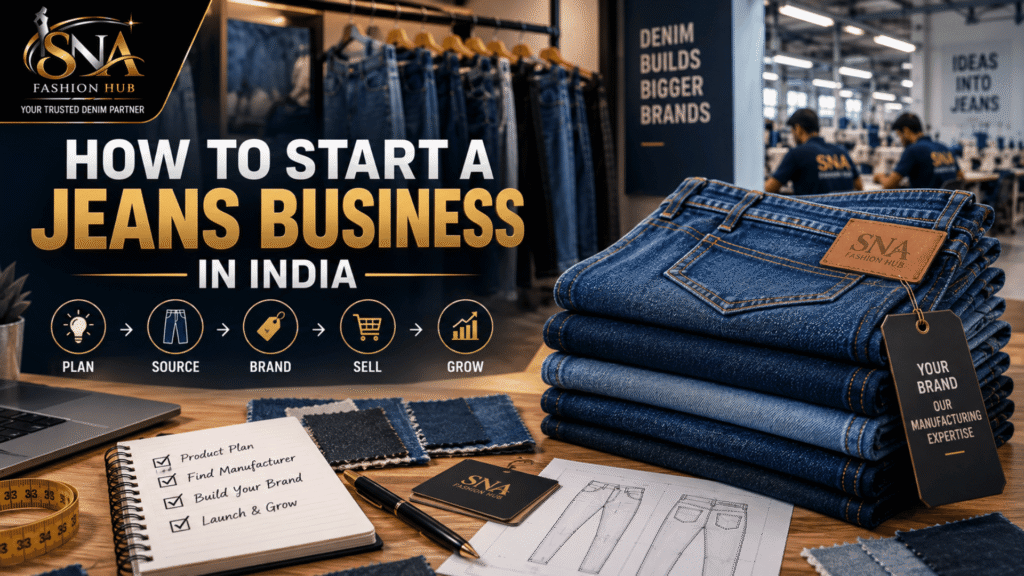
How to Start a Jeans Business in India?
The basic process is:
- Choose your business model.
- Identify your target customer.
- Select jeans categories and fits.
- Decide your fabric and wash requirements.
- Calculate your budget and product cost.
- Find a reliable jeans manufacturer.
- Develop and approve samples.
- Finalise measurements and specifications.
- Add branding and packaging.
- Place your bulk order.
- Inspect the finished products.
- Sell through retail, wholesale or online channels.
For a new seller, the most important rule is simple: understand your customer and product before committing to large-scale inventory.
Is Starting a Jeans Business in India a Good Idea?
A jeans business can be viable because denim is widely used across men’s, women’s and kids’ apparel. However, demand alone does not guarantee profitability.
Your results depend on:
- Product quality
- Manufacturing cost
- Selling price
- Inventory management
- Customer demand
- Returns
- Marketing
- Reliable supply
A retailer selling affordable everyday jeans will have very different requirements from a D2C brand selling premium denim.
What Are the Different Ways to Start a Jeans Business?
Jeans Reselling
Buy ready-made jeans from a supplier and sell them through retail or online channels. This can be a simple entry model for new sellers.
Wholesale Jeans Business
Purchase jeans in bulk and supply them to retailers, distributors or smaller sellers. Competitive pricing, consistent quality and product availability are particularly important.
Private-Label Jeans Brand
A manufacturer produces jeans that you sell under your own brand. Depending on the agreement, you can customise labels, packaging, selected fits, fabrics and washes.
OEM Jeans Manufacturing
OEM production is suitable when you have specific requirements for fit, measurements, fabric, wash, construction, branding and packaging.
Private Label vs OEM: Which Is Better?
| Factor | Private Label | OEM |
| Customisation | Moderate to high | High |
| Product control | Moderate | High |
| Development | Lower | Higher |
| Branding | High | High |
| Best suited for | New brands | Custom products |
Private label can be suitable for launching a brand with a relatively straightforward product strategy, while OEM is useful when product differentiation and specifications are important.
Step 1: Identify Your Target Customer
Before contacting a manufacturer, decide who you want to sell to.
Consider:
- Men, women or kids
- Age group
- Price segment
- Online or offline buyers
- Fashion-focused or value-focused customers
- Preferred fits
- Expected selling price
Your customer determines your product, fabric, fit, wash, price and branding decisions.
Step 2: Choose Your Jeans Products
Your product range could include:
Men’s Jeans: Slim Fit, Regular Fit, Stretch, Ripped and Cross Pocket Jeans.
Women’s Jeans: High Waist, Skinny Fit, Bootcut and Mom Fit Jeans.
Kids’ Jeans: Comfort Fit, Stretchable and Casual Kids Denim.
For a new business, a focused collection can be easier to manage than launching too many untested styles.
Step 3: Choose Fabric, Fit and Wash
Denim fabric affects comfort, durability, appearance, stretch, weight and final cost.
Important considerations include:
- Fabric composition
- Fabric weight
- Stretch
- Base colour
- Wash compatibility
- Target price
Fit is equally important. Depending on your market, you may consider slim, regular, skinny, straight, bootcut, mom, relaxed or wide-leg fits.
Washing can create effects such as fading, vintage appearance, whiskering and distressed finishes. Always approve the desired wash through a sample before bulk production.
Step 4: Calculate Your Jeans Business Investment
There is no fixed investment amount for starting a jeans business. Your capital requirement depends on your business model and production quantity.
Budget for:
- Sampling
- Denim fabric
- Trims
- Manufacturing
- Washing and finishing
- Branding
- Packaging
- Transportation
- Inventory
- Marketing
- Working capital
Do not calculate profitability using only the factory quotation. Consider your complete landed and selling costs.
Step 5: Find a Reliable Jeans Manufacturer in India
Choosing the right manufacturer is one of the most important decisions for a new seller.
Evaluate:
- Manufacturing experience
- Factory infrastructure
- Product capabilities
- MOQ
- Sampling
- Fabric options
- Washing and finishing
- Quality control
- Production capacity
- Private-label capability
- OEM capability
- Branding and packaging
- Lead time
- Repeat-order capability
Do not choose a manufacturer solely because of the lowest price. Poor quality can create returns, replacements and damage to your brand reputation.
What Should You Ask a Jeans Manufacturer?
Before placing an order, ask:
- What is your MOQ?
- Do you manufacture men’s, women’s and kids’ jeans?
- Do you offer private-label and OEM production?
- Can you develop samples?
- What denim fabrics are available?
- Can you provide custom fits and washes?
- What quality-control process do you follow?
- What is your production capacity?
- Can you provide labels and packaging?
- What is the expected production timeline?
- Can you support repeat orders?
Always evaluate physical samples before approving bulk production.
Step 6: Approve Your Sample and Tech Pack
A sample should be checked for:
- Waist and hip measurements
- Rise and inseam
- Thigh and leg opening
- Overall fit
- Fabric and stretch
- Stitching
- Pockets
- Zipper and buttons
- Wash and colour
- Labels
- Finishing
For custom OEM production, a tech pack can document measurements, fabric, construction, trims, wash, branding and packaging requirements.
The normal process is:
Requirement → Sample → Fit Check → Corrections → Final Approval → Bulk Production
Step 7: Understand MOQ and Production Capacity
MOQ means Minimum Order Quantity. It varies according to the manufacturer, product, fabric, colour and customisation.
SNA Fashion Hub states a 1,000-piece MOQ for its bulk manufacturing operations and a stated production capacity of 100,000+ pieces.
Always confirm the applicable MOQ and production schedule for your specific order.
How Is a Pair of Jeans Manufactured?
A typical manufacturing process includes:
Fabric Selection → Pattern Making → Cutting → Stitching → Washing → Finishing → Quality Control → Labelling → Packaging → Dispatch
Each stage affects the consistency and final appearance of the product.
Step 8: Build Your Jeans Brand
If you want to create a long-term clothing business, branding should go beyond a logo.
Consider:
- Brand name
- Target customer
- Price positioning
- Product identity
- Labels
- Hang tags
- Care labels
- Packaging
- Visual identity
Private-label manufacturing can help businesses build their own branded product line without establishing a complete manufacturing facility.
Step 9: Decide Where to Sell
Online
You can sell through:
- Your own website
- Amazon
- Flipkart
- Meesho
- Shopify
Online selling requires strong product listings, photography, marketing, customer service and return management.
Offline
Potential channels include:
- Retail stores
- Boutiques
- Wholesale markets
- Distributors
- Multi-brand stores
Many businesses combine online and offline sales.
Step 10: Manage Your Inventory
Fashion inventory can become complicated because every style, colour and size creates additional SKUs.
For example, 5 styles × 3 colours × 5 sizes = 75 potential SKUs.
Track your:
- Best-selling styles
- Sizes
- Colours
- Slow-moving products
- Returns
- Repeat purchases
Use sales data to determine which products deserve reorders.
What Mistakes Should New Jeans Sellers Avoid?
Avoid:
- Choosing a manufacturer only on price
- Ordering too many untested styles
- Skipping sample approval
- Ignoring size measurements
- Not understanding MOQ
- Calculating only manufacturing cost
- Failing to plan repeat production
- Holding excessive inventory
A focused product range and reliable manufacturing partner can reduce many of these risks.
How to Start a Jeans Business in Sonipat?
Kundli, Sonipat, Haryana is part of the Delhi NCR industrial and manufacturing ecosystem.
SNA Fashion Hub operates from:
Plot No. 401, Phase 4, Industrial Estate, Sector 57, Kundli, Sonipat, Haryana – 131028, India.
The company focuses on B2B jeans and apparel manufacturing for retailers, wholesalers, distributors, online sellers, fashion startups, private-label brands and export buyers.
SNA Fashion Hub: Jeans Manufacturer in India
SNA Fashion Hub is a B2B jeans manufacturer, denim garments manufacturer and apparel supplier established in 2017 by Manish Wadhwa.
Its services include:
- Bulk Jeans Manufacturing
- Private-Label Manufacturing
- OEM / Custom Branding
- Denim Product Development
- Custom Wash & Finishing
- Packaging & Labelling
- Bulk Order Fulfillment
- Men’s, Women’s & Kidswear Manufacturing
- Pan-India & Global Supply
The company states that its manufacturing facility has 11,000+ sq. ft. of factory area, 120+ advanced machines and a stated production capacity of 3,500+ pieces per day.
Final Checklist for New Jeans Sellers in 2026
Before placing your first order, confirm:
- Target customer
- Product category and fit
- Fabric and wash
- Size chart
- Sample approval
- Manufacturer and MOQ
- Production quantity
- Branding and packaging
- Quality-control requirements
- Delivery timeline
- Selling channel
- Inventory and reorder plan
Starting a jeans business is not simply about finding the cheapest supplier. A successful business needs the right product, customer, pricing, quality and manufacturing partner.
If you are looking for bulk, private-label or OEM jeans manufacturing, SNA Fashion Hub can be considered as a B2B manufacturing partner based in Kundli, Sonipat, Haryana, serving buyers across India and global markets.
SNA Fashion Hub: Plot No. 401, Phase 4, Industrial Estate, Sector 57, Kundli, Sonipat, Haryana – 131028, India
Phone: +91 98103 41449 / 0130-3503372
Email: snafashionhub@gmail.com