
Polyester Febric
Introduction: Why Polyester Matters in Denim Manufacturing?
Polyester is one of the most important functional fibers used in modern denim jeans manufacturing. It is not used to replace cotton but to improve stability, durability, and production consistency in bulk denim production.
In real manufacturing systems, polyester directly influences:
- Shrinkage control after washing
- Fabric strength and durability
- Color stability during dyeing
- Cutting and stitching consistency
Overview Summary: Polyester in denim is used to improve durability, reduce shrinkage, and stabilize fabric structure during manufacturing and washing cycles.
What is polyester in denim fabric?
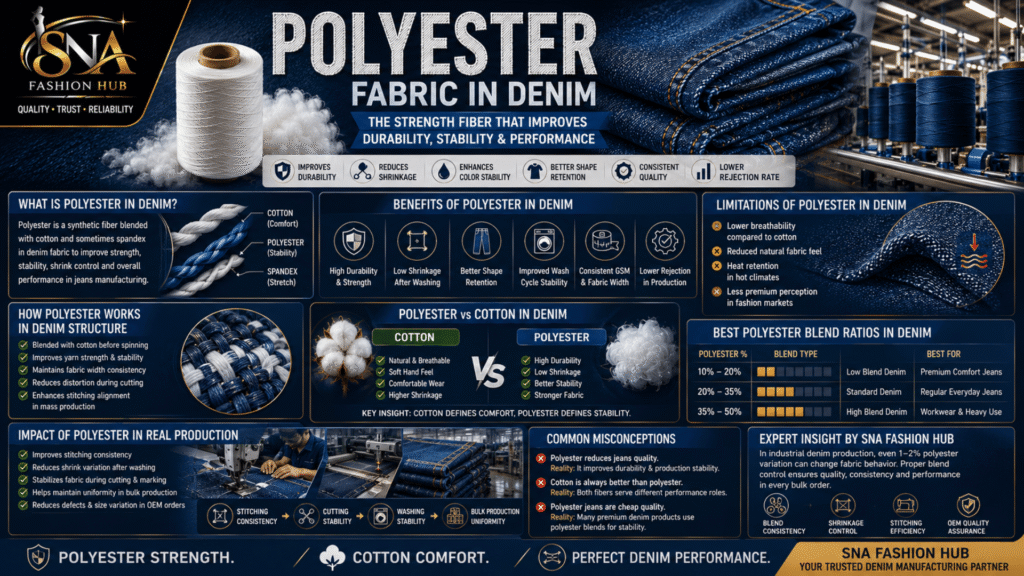
Polyester in denim is a synthetic fiber blended with cotton and sometimes spandex to improve fabric strength, stability, and wash performance in jeans manufacturing.
It is typically introduced during:
- Yarn spinning stage
- Fabric blending stage before weaving
The purpose is not to make jeans fully synthetic, but to enhance performance consistency in production and usage.
Important Link to Know More about Denim
What is Denim Fabric? | How Denim Fabric Is Produced | Types of Denim Washes | Types of Denim Used in Indian Garment Industry
Why is polyester used in jeans manufacturing?
Polyester is used in denim production for functional and operational reasons, not just cost.
Key manufacturing purposes include:
- Reducing shrinkage after washing
- Improving fabric durability under stress
- Maintaining consistent GSM and fabric width
- Enhancing dye and color stability
- Reducing production rejection rates in bulk orders
In industrial denim production, polyester helps maintain batch-to-batch uniformity, which is critical for OEM and wholesale manufacturing.
How does polyester work in denim fabric structure?
Polyester works at the fiber integration level and affects how denim behaves during production and washing.
Yarn-level integration
Polyester fibers are blended with cotton before spinning yarn. This controls:
- Strength balance
- Shrinkage behavior
- Stretch stability
Weaving structure interaction
In denim weaving (usually twill weave), polyester stabilizes yarn tension, helping:
- Maintain fabric width consistency
- Reduce distortion during cutting
- Improve stitching alignment in mass production
Manufacturing insight: Even small polyester percentage changes can impact fabric cutting precision in large-scale garment production.
What are the benefits of polyester in denim?
Polyester provides several functional advantages in denim manufacturing:
- Improves fabric durability under abrasion
- Reduces shrinkage after washing
- Enhances shape retention in finished jeans
- Improves wash cycle stability in bulk production
- Reduces rejection rate in factory output
From a production perspective, polyester ensures higher efficiency and lower variability.
What are the limitations of polyester in jeans?
Despite its advantages, polyester also has functional limitations:
- Lower breathability compared to cotton
- Reduced natural fabric feel
- Heat retention in hot climates
- Less premium perception in fashion markets
Manufacturing reality: Polyester is rarely used alone in denim because it cannot replicate the natural comfort of cotton.
Polyester vs Cotton in denim
Both fibers serve different roles in denim manufacturing.
Cotton
- Natural comfort and breathability
- Soft hand feel
- Higher shrinkage risk
Polyester
- High durability and strength
- Low shrinkage
- Better structural stability
Key manufacturing insight: Cotton defines comfort, polyester defines stability. The final jeans quality depends on balancing both.
What are the best polyester blend ratios in denim?
Polyester usage depends on product category and end use.
Common industrial ratios:
- Low blend denim → cotton-heavy with small polyester percentage
- Standard jeans → balanced cotton-polyester mix
- Workwear denim → higher polyester for durability
Manufacturing insight: Higher polyester improves strength but reduces softness, so balance is critical.
How does polyester affect jeans quality in real production?
In real denim manufacturing systems, polyester impacts multiple stages:
- Improves stitching consistency during sewing
- Reduces fabric shrink variation after washing
- Stabilizes fabric during cutting and marking
- Helps maintain uniformity in bulk production batches
For OEM manufacturing, polyester is often used to reduce production defects and size variation issues.
Common misconceptions about polyester in denim
Myth 1: Polyester reduces jeans quality
Reality: It improves durability and production stability.
Myth 2: Cotton is always better than polyester
Reality: Cotton improves comfort, but polyester improves performance.
Myth 3: Polyester jeans are cheap quality
Reality: Many premium industrial denim products use polyester blends for stability.
Expert manufacturing insights by SNA Fashion Hub
In industrial denim manufacturing environments like SNA Fashion Hub (Kundli, Sonipat, India), fabric blending decisions are made before sampling because:
- Even 1–2% fiber variation changes fabric behavior
- Polyester ratio affects cutting accuracy in bulk orders
- Fabric stability directly impacts stitching efficiency
- Shrinkage control is essential for OEM consistency
For large-scale production, consistency is more important than fiber type alone.
Conclusion
Polyester plays a critical role in modern denim jeans manufacturing by improving durability, reducing shrinkage, and stabilizing production output.
However, it is not a replacement for cotton. Instead, it works as a support fiber that enhances performance and manufacturing consistency.
In real production systems, the best denim quality comes from the correct balance of cotton, polyester, and sometimes spandex, depending on end-use requirements.