
Fabric Blending in Denim Jeans Manufacturing
Introduction: Why Fabric Blending Matters in Jeans Manufacturing
Fabric blending is one of the most important upstream decisions in jeans manufacturing because it directly determines how the final garment will fit, stretch, and perform after washing.
At SNA Fashion Hub, a Delhi NCR-based denim jeans manufacturer, fabric selection is treated as a product engineering decision rather than just a sourcing choice. Every blend—whether cotton-heavy, stretch-based, or polyester-mixed—affects how jeans behave during cutting, stitching, washing, and final wear.
In simple terms:
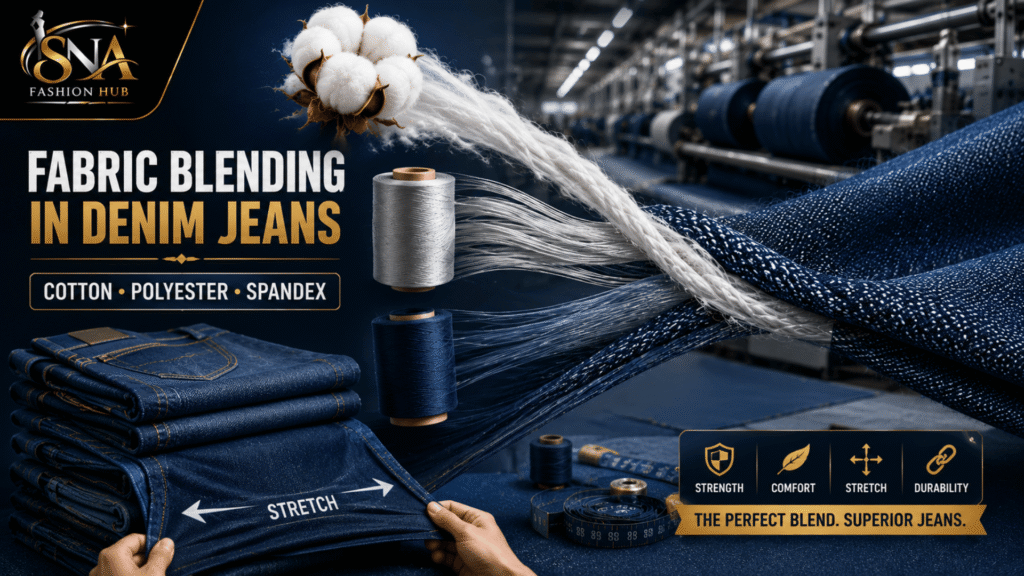
Fabric blending in denim jeans manufacturing refers to selecting and combining fibers like cotton, polyester, and spandex to create denim fabric that meets specific fit, durability, and cost requirements for finished jeans.
This article explains how these fibers influence jeans production, not fabric production, and how manufacturers optimize blends for bulk OEM and private label orders.
What Is Fabric Blending in Jeans Manufacturing?
Fabric blending in jeans manufacturing is the selection of fiber composition—typically cotton, polyester, and spandex—used in denim fabric that is later cut and stitched into finished jeans garments.
It is NOT fabric creation inside a jeans factory. Instead, it is a sourcing and specification stage that defines:
- Fit behavior of jeans
- Stretch and recovery
- Shrinkage after washing
- Production efficiency
- Cost per garment
Core Fibers Used in Denim Jeans Manufacturing
1. Cotton – The Base Structure of Jeans Fabric
Cotton is the primary fiber used in most denim jeans.
Why it matters in jeans manufacturing:
- Gives jeans their natural rugged structure
- Provides breathability and comfort
- Supports fading effects in wash processes
- Maintains traditional denim feel
Manufacturing insight:
In jeans production, higher cotton content leads to:
- Rigid jeans (100% cotton)
- Strong whisker fading after washing
- Higher shrinkage risk (requires controlled washing)
For bulk manufacturing, cotton-heavy fabrics require strict quality checks during pre-production sampling to avoid size variation after wash cycles.
2. Polyester – Stability Fiber in Jeans Production
Polyester is used to improve structural consistency in denim fabric used for jeans.
Why manufacturers use it:
- Reduces shrinkage variation across batches
- Improves durability in heavy-use jeans
- Helps maintain consistent sizing in bulk production
- Reduces overall fabric cost for mass-market jeans
Production reality:
In OEM jeans manufacturing:
- Polyester blends improve efficiency in large-volume orders
- Reduce rejection rates in stitching and washing stages
- Improve consistency for export-quality orders
However, excessive polyester reduces comfort perception, so it is carefully balanced depending on target market.
3. Spandex (Elastane) – Stretch Engineering for Modern Jeans
Spandex is the key fiber responsible for stretchability in modern jeans.
Role in jeans manufacturing:
- Enables slim fit, skinny fit, and body-fit jeans
- Improves movement flexibility
- Enhances recovery after wearing
- Prevents knee-bagging effect
Factory-level insight:
Even 2–5% spandex changes production behavior significantly:
- Requires controlled stitching tension
- Needs stretch-compatible sewing machines
- Demands precise washing temperature control
- Impacts size grading across SKUs
In high-volume production environments like SNA Fashion Hub’s 120+ machine setup, spandex fabrics require skilled operators to maintain seam stability.
Common Fabric Blending Types Used in Jeans Manufacturing
1. Rigid Jeans Fabric
- 100% Cotton
- No stretch
- Used in vintage and workwear jeans
2. Comfort Stretch Jeans Fabric
- 98% Cotton + 2% Spandex
- Most common in men’s slim fit jeans
- Balanced comfort and structure
3. Performance Stretch Jeans Fabric
- 90–95% Cotton + 3–5% Spandex + Polyester mix
- Used in fashion jeans and export orders
4. Economy Bulk Jeans Fabric
- Cotton + higher polyester ratio
- Used for mass retail and low-cost production
How Fabric Blending Impacts Jeans Manufacturing Process
Fabric blending affects every stage of jeans production:
1. Cutting Stage
- Stretch fabrics require directional accuracy
- Polyester blends reduce fabric shifting
- Cotton fabrics require careful layering stability
2. Stitching Stage
- Spandex requires controlled thread tension
- Stretch fabrics need specialized machines
- Improper handling causes seam waviness
3. Washing & Finishing Stage
- Cotton creates stronger fade contrast
- Polyester stabilizes color retention
- Spandex requires controlled enzyme wash cycles
4. Quality Control Stage
Manufacturers test:
- Shrinkage after wash
- Stretch recovery
- Seam durability
- Color fastness
Technical Parameters That Matter in Jeans Fabric Selection
GSM (Fabric Weight)
- 220–300 GSM → Lightweight jeans
- 300–400 GSM → Standard denim jeans
- 400+ GSM → Heavy-duty jeans
Stretch Ratio
- 2% spandex → Light comfort stretch
- 5%+ spandex → High stretch fashion jeans
Fabric Behavior
- Cotton-heavy → structured, rigid feel
- Polyester blend → stable, consistent sizing
- Spandex blend → flexible, fitted silhouette
Why Fabric Blending Is Critical for OEM Jeans Manufacturing
For a B2B jeans manufacturer like SNA Fashion Hub, fabric blending impacts:
- Bulk production consistency
- Private label fit standards
- Export quality control
- Pricing structure per garment
- Customer segment targeting
This is especially important when supplying:
- Retail chains
- Online sellers (Amazon, Flipkart, Meesho)
- Fashion startups
- Export buyers
- Wholesale distributors
Common Problems in Jeans Manufacturing Due to Fabric Blends
1. Size Variation After Wash
Occurs in high cotton fabrics if pre-shrinking is not controlled.
2. Stretch Loss in Spandex Jeans
Caused by improper heat-setting during finishing.
3. Seam Twisting in Stretch Denim
Due to incorrect stitching tension.
4. Color Inconsistency in Blends
Polyester content affects dye absorption behavior.
Expert Manufacturing Insights (From Real Production Practice)
From a jeans manufacturing perspective:
- Fabric blending is selected BEFORE production, not during manufacturing
- Small changes in spandex ratio completely change fit grading
- Cotton-heavy fabrics require more wash control cycles
- Polyester improves bulk production efficiency but reduces premium perception
- Machine calibration must match fabric elasticity level
These are real operational constraints in bulk jeans manufacturing systems.
Common Misconceptions About Denim Fabric Blending
Misconception 1: Jeans factories control fabric blending
Incorrect — jeans manufacturers select fabrics; textile mills create blends.
Misconception 2: More stretch always means better jeans
Wrong — too much stretch reduces structural durability.
Misconception 3: Polyester jeans are low quality
Not always — many export and uniform jeans use polyester blends for durability.
Conclusion: Fabric Blending Defines Jeans Performance Before Production Begins
Fabric blending is a critical upstream decision in jeans manufacturing that directly affects final garment quality, fit, and scalability.
For manufacturers like SNA Fashion Hub, fabric selection is not a textile discussion—it is a production engineering decision that impacts:
- Fit consistency
- Bulk order stability
- OEM scalability
- Customer satisfaction
- Cost efficiency
Understanding cotton, polyester, and spandex behavior helps brands and buyers make better sourcing decisions and ensures consistent quality across large-scale jeans production.
Important Link to Know More about Denim
What is Denim Fabric? | How Denim Fabric Is Produced | Types of Denim Washes | Types of Denim Used in Indian Garment Industry