
Spandex Febric
Introduction: Why Spandex Changed Modern Denim Jeans
Spandex (also called elastane or Lycra) is a small-percentage fiber that has completely changed how modern denim jeans fit and feel. In denim manufacturing, spandex is not used for structure—it is used for controlled stretch and recovery.
Today’s slim, skinny, and stretch-fit jeans are possible mainly because of spandex integration in denim fabric.
Overview Summary: Spandex in denim is a stretch fiber added in small percentages to improve flexibility, fit, and shape recovery in jeans.
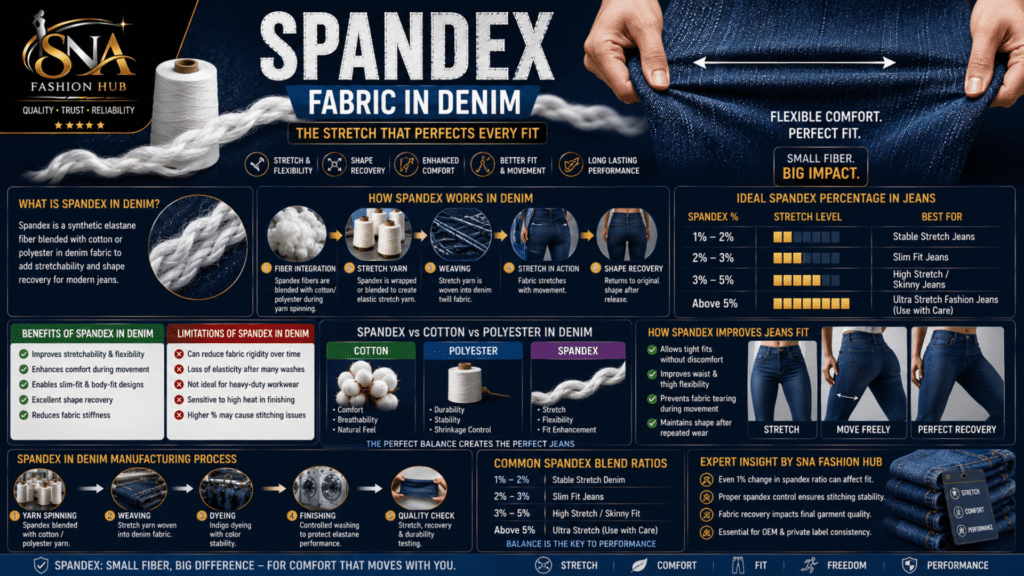
What is spandex in denim fabric?
Spandex is a synthetic elastic fiber blended with cotton or polyester in denim fabric to provide stretchability and shape recovery.
It is usually added during:
- Yarn spinning stage
- Fabric blending stage before weaving
Its main role is not strength or durability, but elastic movement and body-fit comfort.
Important Link to Know More about Denim
What is Denim Fabric? | How Denim Fabric Is Produced | Types of Denim Washes | Types of Denim Used in Indian Garment Industry
Why is spandex used in jeans manufacturing?
Spandex is used in denim production to improve functional wearability.
Key manufacturing purposes:
- Adds stretch to rigid denim fabric
- Improves body movement comfort
- Enables slim and skinny fits
- Helps jeans return to original shape after stretching
- Enhances wearer flexibility in daily use
Manufacturing insight: Without spandex, modern fitted jeans would feel rigid and restrictive during movement.
How does spandex work in denim fabric?
Spandex works by adding elasticity to the yarn structure.
Yarn-level integration
Spandex is wrapped or blended with cotton/polyester yarn to create stretch yarn.
This controls:
- Stretch percentage
- Recovery power (shape return)
- Fabric tension during sewing
Fabric behavior after weaving
Once woven into denim:
- Fabric stretches during movement
- Returns to original shape after release
- Maintains fit over repeated wear
What is the ideal spandex percentage in jeans?
Spandex is always used in low percentages because it is highly elastic.
Common industrial ranges:
- 1%–2% → stable stretch denim
- 2%–3% → slim fit jeans
- 3%–5% → high stretch skinny jeans
Manufacturing insight: Above 5% spandex can cause stitching instability and waistband rolling in mass production.
What are the benefits of spandex in denim jeans?
Spandex provides functional advantages in modern jeans:
- Improves stretchability and flexibility
- Enhances comfort during movement
- Enables slim-fit and body-fit designs
- Improves shape recovery after wear
- Reduces fabric stiffness
In real production, spandex is essential for fashion-fit denim categories.
What are the limitations of spandex in denim?
Despite its benefits, spandex has technical limitations:
- Can reduce fabric rigidity over time
- Slight loss of elasticity after repeated washing
- Not suitable for heavy-duty workwear denim
- Sensitive to high heat during finishing processes
Manufacturing reality: Spandex must be carefully controlled during washing and finishing stages.
Spandex vs Cotton vs Polyester in denim
Each fiber plays a different role:
Cotton
- Comfort and breathability
- Natural fabric feel
Polyester
- Durability and stability
- Shrinkage control
Spandex
- Stretch and flexibility
- Fit enhancement
Key insight: Spandex does not replace cotton or polyester—it enhances movement performance.
How does spandex improve jeans fit?
Spandex directly affects how jeans fit on the body:
- Allows tight fits without discomfort
- Improves waist and thigh flexibility
- Prevents fabric tearing during movement
- Helps jeans maintain shape after repeated wear
Manufacturing insight: Even a 1% change in spandex ratio can significantly alter fit behavior.
How does spandex affect washing and durability?
Spandex reacts differently during washing cycles:
- Maintains shape in early washes
- May lose elasticity after long-term use
- Requires controlled washing temperature
- Works best with enzyme-washed denim finishing
Common mistakes in using spandex in denim manufacturing
- Using too high spandex percentage
- Ignoring fabric recovery testing
- Improper heat exposure during finishing
- Mixing inconsistent stretch yarn batches
Industry insight: Most fit issues in stretch denim come from incorrect spandex tension control.
Expert manufacturing insight by SNA Fashion Hub)
In industrial denim production systems like SNA Fashion Hub (Kundli, Sonipat, India), spandex selection is done before sampling because:
- Stretch percentage directly affects stitching tension
- Fabric recovery impacts final garment fit
- Even minor ratio changes alter bulk production consistency
For OEM and private label jeans, spandex control is critical for fit standardization across large orders.
Conclusion
Spandex plays a critical role in modern denim jeans manufacturing by transforming rigid fabric into flexible, body-fit apparel.
It does not replace cotton or polyester—it enhances their performance by adding stretch and recovery.In professional denim manufacturing, the correct spandex percentage is essential for achieving consistent fit, comfort, and production stability.
Important Link to Know More about Denim
What is Denim Fabric? | How Denim Fabric Is Produced | Types of Denim Washes | Types of Denim Used in Indian Garment Industry