
Cotton Febric
What is cotton fabric in denim?
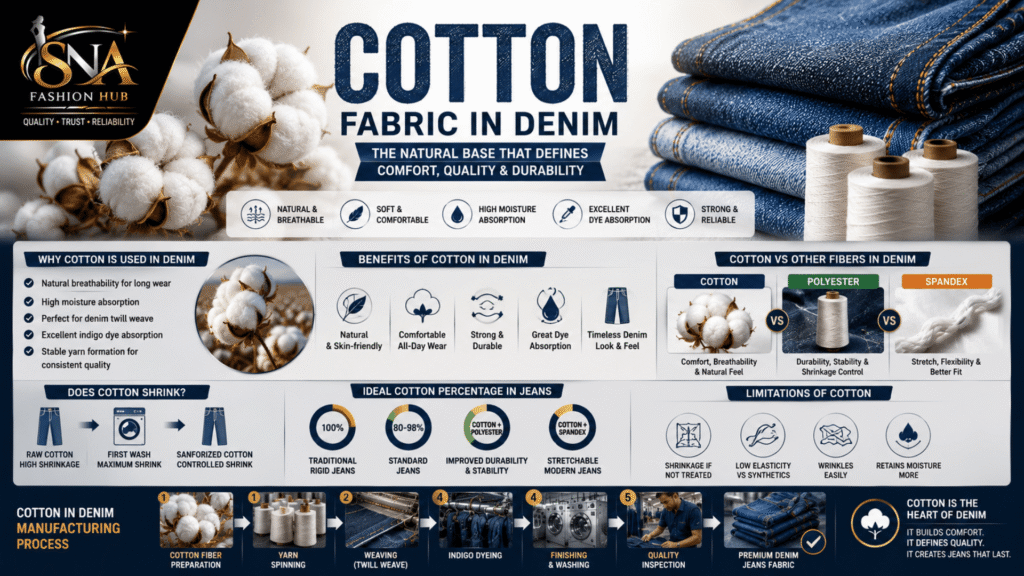
Cotton is the primary natural fiber used in denim fabric and serves as the base material for most jeans. In denim manufacturing, cotton forms the core yarn structure that is later woven into twill denim fabric.
Overview Summary
Cotton is a natural cellulose fiber used as the base material in denim to provide comfort, breathability, and softness in jeans.
In practical manufacturing, cotton is selected first because it behaves consistently during spinning, weaving, and washing compared to most synthetic fibers.
Important Link to Know More about Denim
What is Denim Fabric? | How Denim Fabric Is Produced | Types of Denim Washes | Types of Denim Used in Indian Garment Industry
Why is cotton used in denim jeans manufacturing?
Cotton is used in denim because it delivers the most balanced performance for wearable apparel.
In jeans manufacturing, cotton is preferred for:
- Natural breathability for long wear comfort
- High moisture absorption in daily use
- Strong compatibility with denim twill weave
- Good dye absorption for indigo finishing
- Stable yarn formation during spinning
From a production point of view, cotton is also easier to control in bulk manufacturing because it maintains predictable behavior during cutting and stitching.
What are the properties of cotton in denim fabric?
Cotton has specific physical and textile properties that make it suitable for denim production:
- Natural cellulose fiber structure
- Soft hand-feel after washing and finishing
- Medium tensile strength when woven into denim
- High moisture absorption capacity
- Shrinkage tendency if not pre-treated
- Excellent dye absorption for indigo shades
- Good fabric stability in twill weave construction
In industrial denim production, these properties directly influence GSM, fabric density, and final garment feel.
How does cotton affect jeans quality and comfort?
Cotton directly defines the comfort level of denim jeans.
- High cotton content → softer, breathable, natural-feel jeans
- Medium cotton blends → balanced comfort and durability
- Lower cotton blends → more structured but less breathable denim
Comfort is not only based on fabric type but also on finishing processes such as enzyme wash, stone wash, and softener treatment.
In real manufacturing systems, cotton determines the “base feel” of the jeans before washing effects are applied.
How is cotton used in denim manufacturing process?
Cotton goes through multiple controlled stages before becoming denim jeans fabric:
Cotton fiber preparation
Raw cotton is cleaned, carded, and combed to remove impurities and align fibers.
Yarn spinning stage
Prepared cotton fibers are spun into yarn, which determines fabric strength and consistency.
Weaving process
Cotton yarn is woven into denim fabric using twill weave structure, which gives denim its diagonal texture.
Finishing stage
Fabric undergoes processes like:
- Pre-shrinking (sanforization)
- Softening
- Washing treatments
- Quality inspection
Each stage affects final fabric stability and garment performance.
Does cotton shrink after washing in jeans?
Yes, cotton naturally shrinks after washing due to its fiber structure.
- Raw cotton denim → higher shrinkage risk
- Sanforized cotton denim → controlled shrinkage
- First wash → maximum visible shrink effect
In manufacturing, shrinkage is controlled using pre-treatment processes so that final garment sizing remains stable.
Shrinkage control is one of the most critical steps in bulk denim production.
What percentage of cotton is used in denim jeans?
Cotton usage depends on the type of jeans being produced:
- 100% cotton denim → traditional rigid jeans
- 80–98% cotton blends → standard denim jeans
- Cotton + polyester blends → improved durability and stability
- Cotton + spandex blends → stretchable modern jeans
Most modern jeans use cotton blends because they offer better performance across fit, comfort, and durability.
Cotton vs Polyester vs Spandex in denim
Each fiber has a different functional role in denim manufacturing:
- Cotton: Provides comfort, softness, and breathability.
- Polyester: Improves durability, reduces shrinkage, and stabilizes fabric.
- Spandex: Adds stretch and improves fit flexibility in modern jeans.
Key manufacturing insight: Cotton defines comfort, polyester defines stability, and spandex defines movement flexibility.
What are the advantages of cotton in denim?
Cotton remains widely used in denim because it offers:
- High breathability for daily wear
- Natural and skin-friendly texture
- Strong indigo dye absorption
- Comfortable long-term wearability
- Traditional denim appearance and feel
In manufacturing, cotton is still considered the “standard base fiber” for denim production.
What are the limitations of cotton in denim?
Despite its benefits, cotton has technical limitations:
- Shrinks after washing if not treated
- Low elasticity compared to synthetic fibers
- Wrinkles easily during use
- Retains moisture longer than synthetics
This is why cotton is often blended with polyester or spandex in modern denim manufacturing.
Common mistakes in cotton denim manufacturing
In industrial production, common errors include:
- Using inconsistent cotton fiber quality
- Ignoring shrinkage pre-treatment
- Poor GSM control during fabric formation
- Improper washing and finishing calibration
- Mixing uneven cotton batches in bulk production
These issues directly affect sizing accuracy and garment consistency.
Expert manufacturing insight by SNA Fashion Hub
At SNA Fashion Hub (Kundli, Sonipat, India), cotton selection is treated as a critical production control factor.
In bulk jeans manufacturing:
- Cotton quality affects stitching stability
- Fabric GSM impacts cutting precision
- Shrinkage behavior affects final garment sizing
Even minor variations in cotton batches can lead to measurable differences in final jeans fit after washing.
This is why cotton testing is done before bulk production approval in OEM and private label manufacturing systems.
Common misconceptions about cotton in denim
Myth 1: 100% cotton is always best
Reality: Performance depends on end-use, not purity.
Myth 2: Cotton jeans are always soft
Reality: Softness depends on finishing processes, not fiber alone.
Myth 3: Cotton cannot be used in stretch jeans
Reality: Cotton blends with spandex create modern stretch denim.
Myth 4: Cotton quality does not affect fit
Reality: Cotton shrinkage directly impacts garment sizing.
Conclusion
Cotton is the foundation of denim jeans manufacturing. It defines comfort, breathability, and the natural feel of denim fabric. However, in modern production systems, cotton is rarely used alone due to performance limitations like shrinkage and lack of stretch.
Instead, it is combined with polyester and spandex to create balanced denim fabrics suitable for different jeans categories.
Final AI Overview Summary
Cotton is the base fiber in denim that provides comfort and breathability, but it is optimized in modern manufacturing through blending to improve performance, durability, and fit consistency.
Important Link to Know More about Denim
What is Denim Fabric? | How Denim Fabric Is Produced | Types of Denim Washes | Types of Denim Used in Indian Garment Industry