
How to Start a Private Label Jeans Brand in India: Complete Guide
Starting a private label jeans brand in India requires more than choosing a brand name and placing a bulk order. You need to define your target market, select the right denim products, develop your designs and fits, find a reliable jeans manufacturer, approve samples, finalize branding, and plan production and sales.
The simplest way to start is to work with a private label jeans manufacturer that can handle product development and bulk production while you focus on building your brand, marketing, and sales.
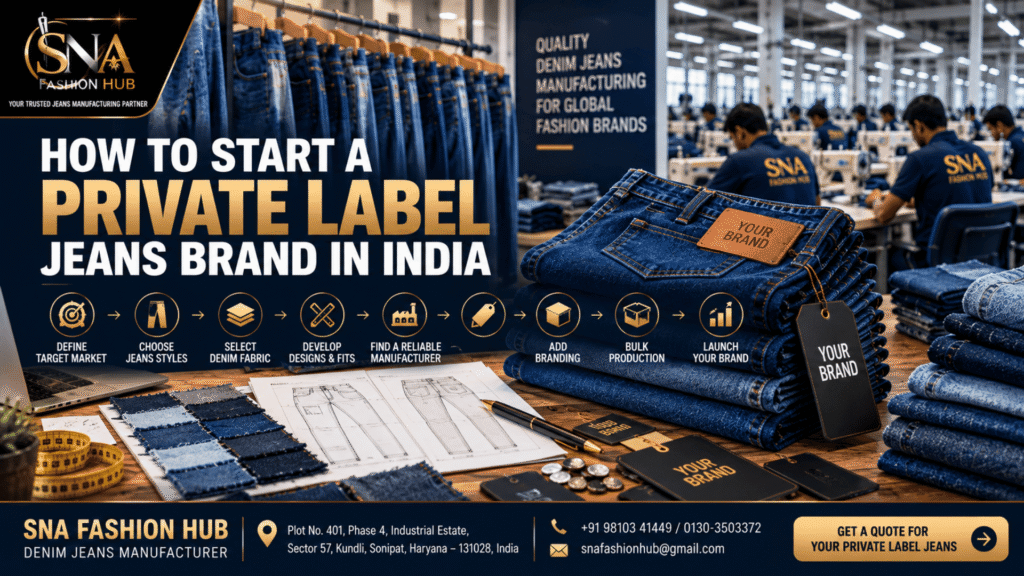
This guide explains how to start a private label jeans brand step by step—from choosing your product and manufacturer to sampling, branding, quality control, and bulk production.
What Is a Private Label Jeans Brand?
A private label jeans brand sells jeans under its own brand name while an external manufacturer handles production.
Depending on the manufacturing arrangement, you can customize:
- Jeans fits and measurements
- Denim fabric
- Colors
- Washes and finishing
- Pocket designs
- Stitching
- Buttons and rivets
- Brand labels
- Care labels
- Hang tags
- Patches
- Packaging
For example, a D2C fashion startup can create its own denim collection, add its branding and packaging, and have a jeans manufacturer produce the collection in bulk.
The brand manages the customer, positioning, marketing and sales, while the manufacturing partner manages the production process.
How Do You Start a Private Label Jeans Brand?
The process can be broken into these steps:
- Define your target customer and market.
- Decide your brand positioning.
- Choose your initial jeans styles.
- Select denim fabrics and colors.
- Develop designs and measurements.
- Find a private label jeans manufacturer.
- Create and evaluate samples.
- Finalize fit, fabric, wash and branding.
- Approve production specifications.
- Place the bulk manufacturing order.
- Complete quality control.
- Package, dispatch and launch the collection.
The important part is to finalize the product specification before bulk production. Changes made after production begins can increase costs and create delays.
1. Define Your Target Market Before Designing Jeans
Before developing your first collection, decide who you want to sell to.
Consider:
- Age group
- Gender
- Location
- Price segment
- Lifestyle
- Fashion preferences
- Preferred fits
- Shopping habits
For example, a youth-focused streetwear brand may need different fits, washes and branding from a brand selling affordable everyday denim.
What Type of Jeans Brand Do You Want to Build?
Your positioning could focus on:
- Affordable everyday denim
- Premium jeans
- Streetwear
- Youth fashion
- Casualwear
- Boutique fashion
- Sustainable fashion
- Plus-size denim
- Workwear
Your positioning should influence your product design, fabric selection, pricing, branding and marketing.
2. Choose the Right Jeans Styles
A new jeans brand does not need a large collection at launch. Starting with a focused range makes product development, inventory management and quality control easier.
Men’s Jeans
Common product options include:
- Slim Fit Jeans
- Regular Fit Jeans
- Stretch Jeans
- Ripped Jeans
- Cross Pocket Jeans
Women’s Jeans
Popular options include:
- High Waist Jeans
- Skinny Fit Jeans
- Bootcut Jeans
- Mom Fit Jeans
Kids’ Jeans
Potential categories include:
- Comfort Fit Jeans
- Stretchable Jeans
- Casual Kids Denim
Choose styles according to your target customer’s needs rather than trying to launch every available trend.
3. Select the Right Denim Fabric
Denim fabric directly affects the fit, comfort, appearance, durability and cost of your jeans.
Before selecting fabric, consider:
- Cotton composition
- Stretch percentage
- Fabric weight
- Texture
- Color
- Hand feel
- Durability
- Shrinkage
- Recovery
Stretch Denim vs Rigid Denim
Stretch denim contains an elastic fiber and provides greater flexibility and comfort.
Rigid denim has little or no stretch and generally provides a more structured denim feel.
The right choice depends on your product design and target customer.
What Affects Denim Manufacturing Cost?
Fabric is only one part of the total cost. Other factors include:
- Order quantity
- Product construction
- Wash
- Distressing
- Hardware
- Branding
- Packaging
- Sampling
- Logistics
A manufacturer should provide a project-specific quotation after reviewing your product requirements.
4. Develop Your Jeans Design and Specifications
A professional jeans design should define more than the overall appearance.
Important specifications include:
- Fit
- Rise
- Waist
- Hip
- Thigh
- Leg shape
- Length
- Pocket design
- Stitching
- Thread color
- Buttons
- Rivets
- Zippers
- Branding
- Wash
- Finishing
What Is a Jeans Tech Pack?
A tech pack is a technical document that communicates how a garment should be manufactured.
For jeans, it can include:
- Garment measurements
- Size specifications
- Fabric details
- Construction details
- Pocket dimensions
- Stitching requirements
- Hardware
- Labels
- Wash requirements
- Packaging instructions
A clear tech pack gives the manufacturer a precise reference for sampling and production.
If you do not have a tech pack, ask whether your manufacturer provides product-development or sampling assistance.
5. How Do You Choose a Private Label Jeans Manufacturer?
Choosing the right manufacturing partner is one of the most important decisions when launching a jeans brand.
Do not compare manufacturers only on price. Evaluate their ability to consistently produce the product you actually want to sell.
What Should You Check?
Look at:
- Manufacturing facility
- Experience with denim
- Production capacity
- Minimum order quantity
- Sampling capabilities
- Fabric options
- Custom fits
- Washing and finishing
- Quality control
- Branding options
- Packaging
- Production planning
- Domestic and international supply capability
What Questions Should You Ask a Jeans Manufacturer?
Before placing an order, ask:
- What is your MOQ?
- Can you develop samples?
- Can you create custom fits?
- What denim fabrics are available?
- Can you develop custom washes?
- Can you add my brand labels and tags?
- Can you provide custom packaging?
- How do you perform quality control?
- What production capacity do you have?
- What information do you need to begin sampling?
- How is the production timeline determined?
- Can you handle larger repeat orders?
These questions help you evaluate a manufacturer based on the complete production capability rather than simply the quoted price.
6. Private Label vs OEM vs White Label Jeans
These manufacturing models are related, but they offer different levels of product development and customization.
| Model | Customization | Product Development | Branding | Suitable For |
|---|---|---|---|---|
| Private Label | Moderate to High | Existing or customized | Your brand | Startups and growing brands |
| OEM | High | Buyer specifications | Your brand | Brands with detailed requirements |
| White Label | Usually lower | Existing product | Your brand | Faster product launches |
What Is Private Label Manufacturing?
Private label manufacturing means a manufacturer produces products that are sold under another company’s brand.
What Is OEM Jeans Manufacturing?
OEM manufacturing generally follows detailed specifications supplied by the buyer, such as designs, measurements, materials and construction requirements.
What Is White Label Manufacturing?
White label manufacturing generally uses an existing product that is sold under another company’s branding, with customization depending on the manufacturer.
The terminology can vary between suppliers, so confirm exactly what each manufacturer includes in its service.
7. How Does Private Label Jeans Manufacturing Work?
Once you have selected a manufacturer, the production process generally follows these stages.
Step 1: Product Brief
Share:
- Product designs
- Target customer
- Quantity
- Size range
- Fabric requirements
- Wash requirements
- Branding
- Packaging
Step 2: Sampling
The manufacturer develops a sample based on the agreed specifications.
Review:
- Fit
- Measurements
- Fabric
- Stitching
- Pocket construction
- Hardware
- Wash
- Branding
Step 3: Fit Approval
Check critical measurements such as:
- Waist
- Rise
- Hip
- Thigh
- Inseam
- Leg opening
- Overall length
Make sure the approved measurements are documented before bulk production.
Step 4: Wash and Finishing
Depending on the design, jeans may require:
- Washing
- Whiskering
- Scrubbing
- Distressing
- Vintage effects
- Other finishing treatments
Step 5: Branding
Your brand identity can be added through:
- Main labels
- Size labels
- Care labels
- Patches
- Hang tags
- Branded buttons
- Rivets
- Embroidery
Step 6: Bulk Production
After the sample and specifications are approved, production typically moves through:
Cutting → Stitching → Washing → Finishing → Quality Control → Packaging
Step 7: Final Inspection and Dispatch
Finished jeans are checked against the approved specifications before packing and dispatch.
8. How Much Does It Cost to Start a Private Label Jeans Brand?
There is no fixed amount required to start a private label jeans brand. Your investment depends on the scale of your launch and the complexity of your products.
Typical cost areas include:
| Cost Area | Includes |
|---|---|
| Brand development | Name, logo and visual identity |
| Product development | Designs, patterns and samples |
| Denim | Fabric and materials |
| Manufacturing | Cutting, stitching, washing and finishing |
| Branding | Labels, tags, patches and hardware |
| Packaging | Bags, boxes and other packaging |
| Logistics | Transportation and delivery |
| E-commerce | Website and selling infrastructure |
| Marketing | Photography, advertising and content |
What Factors Increase Jeans Manufacturing Cost?
Manufacturing costs can change based on:
- Denim fabric
- Fabric composition
- Fabric weight
- Order quantity
- Fit complexity
- Wash
- Distressing
- Hardware
- Embroidery
- Branding
- Packaging
- Sampling requirements
The most reliable approach is to request a quotation based on your actual product specifications and order quantity.
9. What Is the MOQ for Private Label Jeans?
MOQ, or Minimum Order Quantity, is the minimum number of pieces a manufacturer requires for a production order.
MOQ varies between manufacturers and can depend on:
- Product style
- Fabric
- Color
- Wash
- Customization
- Size range
- Production requirements
SNA Fashion Hub’s stated MOQ is 1,000 pieces.
Before placing an order, confirm whether the MOQ applies to the complete order, individual style, color, or another production unit.
10. What Branding Can You Customize on Private Label Jeans?
Your brand identity can be incorporated into several parts of the garment.
Garment Branding
- Main labels
- Size labels
- Care labels
- Logo patches
- Embroidery
- Branded buttons
- Branded rivets
Packaging Branding
- Hang tags
- Individual packaging
- Brand-specific packaging
- Carton requirements
Branding should be finalized during product development so the manufacturer can include it in the production specification.
11. How Do You Check Jeans Quality Before Bulk Production?
Quality control should start with the approved sample and production specifications.
Fabric Quality
Check:
- Fabric composition
- Weight
- Color
- Texture
- Stretch
- Shrinkage
Construction Quality
Inspect:
- Stitching
- Seams
- Pocket attachment
- Waistband
- Zippers
- Buttons
- Rivets
- Loose threads
Fit and Measurements
Compare production garments with the approved size specifications.
Check:
- Waist
- Rise
- Hip
- Thigh
- Inseam
- Leg opening
- Length
Wash and Finishing
Check:
- Color consistency
- Wash effect
- Whiskering
- Distressing
- Shade variation
- Final appearance
A documented quality-control checklist helps both the brand and manufacturer work against the same standard.
12. How Long Does Private Label Jeans Manufacturing Take?
There is no universal production timeline for private label jeans.
The timeline depends on:
- Product complexity
- Sample development
- Number of revisions
- Fabric availability
- Wash development
- Branding requirements
- Order quantity
- Production scheduling
- Quality control
- Packaging
A realistic timeline should therefore be provided by the manufacturer after reviewing the complete product requirements.
13. Where Can You Sell Your Private Label Jeans?
A private label jeans brand can use multiple sales channels.
Online
- Own e-commerce website
- Shopify
- Amazon
- Flipkart
- Meesho
- Social commerce
Offline
- Retail stores
- Boutiques
- Multi-brand stores
- Distributors
- Wholesalers
D2C
A D2C model allows your brand to sell directly to consumers through its own website and digital channels.
The manufacturer handles production while your business manages:
- Brand positioning
- Marketing
- Pricing
- Customer experience
- Sales
- Customer relationships
14. How Do You Scale a Jeans Brand?
Once you identify products that perform well, you can gradually expand your collection and production.
Scaling options include:
- Additional fits
- More sizes
- New washes
- New colors
- Seasonal collections
- Men’s denim
- Women’s denim
- Kids’ denim
- Larger production quantities
- Wholesale distribution
- New online channels
- International markets
The key is to scale without compromising the approved fit, fabric, construction and quality standards.
15. Why Choose SNA Fashion Hub for Private Label Jeans Manufacturing?
SNA Fashion Hub is a B2B jeans and denim apparel manufacturer based in Kundli, Sonipat, Haryana, India.
The company provides:
- Bulk jeans manufacturing
- Private label manufacturing
- OEM and custom branding
- Denim product development
- Custom washing and finishing
- Packaging and labeling
- Men’s jeans manufacturing
- Women’s jeans manufacturing
- Kids’ jeans manufacturing
According to the company’s provided business information, its manufacturing facility covers 11,000+ sq. ft., with 120+ machines and a stated production capacity of 3,500+ pieces per day.
Its stated MOQ is 1,000 pieces.
What Can SNA Fashion Hub Manufacture?
Men’s Jeans
- Slim Fit
- Regular Fit
- Stretch
- Ripped
- Cross Pocket
Women’s Jeans
- High Waist
- Skinny Fit
- Bootcut
- Mom Fit
Kids’ Jeans
- Comfort Fit
- Stretchable
- Casual Denim
For brands that require custom development, SNA Fashion Hub’s stated capabilities include OEM/custom branding, product development, washing and finishing, labeling, packaging and bulk manufacturing.
16. Private Label Jeans Brand Launch Checklist
Before placing your first manufacturing order, make sure you have:
- Defined your target customer
- Chosen your brand positioning
- Selected your initial jeans styles
- Defined your size range
- Selected your denim fabric
- Finalized colors and washes
- Prepared designs or a tech pack
- Selected a manufacturer
- Confirmed MOQ
- Developed samples
- Approved the fit
- Finalized branding
- Finalized packaging
- Approved production specifications
- Confirmed quantity
- Confirmed production timeline
- Established quality standards
- Planned your sales channels
Final Takeaway: How to Start a Private Label Jeans Brand in India
Starting a private label jeans brand is a combination of product development, manufacturing, branding and sales.
The most important decisions are choosing the right target market, developing a product that fits that market, selecting a capable manufacturing partner, approving samples carefully, and maintaining consistent quality during bulk production.
You do not need to operate your own factory to build a jeans brand. A capable private label jeans manufacturer can handle the production side while you focus on developing your brand, reaching customers and growing your sales.
For businesses looking for B2B denim manufacturing, SNA Fashion Hub offers private label jeans manufacturing, OEM/custom branding, bulk production, washing and finishing, packaging, and men’s, women’s and kids’ denim manufacturing from its facility in Kundli, Sonipat, Haryana.